Starting Over: A Comprehensive Project Blog
Page 4: 2/8/2020 through 12/20/20
Go to "Starting Over" Page 1: (7/2015 through 2/2018)
Go to "Starting Over" Page 2: (3/6/2018 through 3/6/2019)
Go to "Starting Over" Page 3: (3/6/2018 through 1/6/2020)
Go to "Starting Over" Page 5: (12/21/20 to Present)
Go to "Starting Over" Table of Contents
Go to "Starting Over" Alphabetical Index
Center Bench Overview and a Rough Layout for the West Slope and an Industrial Park
2-8-2020
Now that all the mainline track and the terminal yard ladder track is laid and wired, I can continue with the scenery on the center bench. I have a rough idea of what I want, so I first created a very rough little sketch of the of the entire bench, dividing it in to six areas:
I'll begin with the West Slope and Industrial Park, first creating a rough topographical sketch as usual. This is the area to the South of the hinged terminal building terrace, which will abut the South side of that terrace along the edge of a large Southern Railway office/freight building that will stretch the length of the Southern edge of the hinged terminal terrace. The adjoining wooded/grassy slope will descend from the +5 East-West cross tracks above the terminal building to a small terrace at +2 1/2 above bench +0, and then to a large terrace at +2 inches above bench +0. The two siding tracks will ascend up from the mainline farther to the east on an 8 foot (2%)grade to the +2 terrace and terminate at the end of the +2 terrace. There will be two roads, both originating at tunnel portals in the descending slope. A steep bank just to the north of the northern-most road will tie in to bench level +0 at the edge of the bench via a step embankment with a few rock outcroppings.
Next, Ill install the terrace for the mine (this has now changed of a large saw mill) at +1 above bench +0 with a 1 1/2% graded roadbed connecting to the turnout on the north side of the mainline parallel to and just to the East the traverse track.
Now, I'll lay and wire all the rest of the track on the center bench.
Planning and Constructing Structures for the Center Bench
2/15/2020
I have said many times in this blog, that, when laying out an area, it is useful to have the structures already completed. This allows for experimentation regarding placement and for the on-going evaluation of the overall look of the section under construction. The center bench will be covered with track-side, factories and warehouses, not only in the industrial park pictured below, but also along the long siding on the North edge of the bench and along the entrances to the terminal. I have ordered 15 structure kits (mostly Cornerstone and Blairline), and to help with the selection and the layout of the various sections, I have created cut-out foot prints of each selected structure with a photo of the finished kit on the cut-out. I will also refurbish 3 large factories that had been kit bashed and used on the A&BR1.
Completing the West Slope and the Industrial Park
3/14/2020
Completing the Altamont Terminal Complex
3/22/2020
Although the upper levels of the terminal with the main terminal building and the two freight houses are pretty much complete, there is still a great deal of work to be done below along the terminal yard ladder including doubling the size of the train shed, constructing and installing a dozen or so more platforms and lighting the sheds and covered platforms, as well as adding five freight sheds, and a half dozen track side warehouses and light factories. When this is all done, I'll ballast all the track.
Installing Turnouts for the Shop Area.
4-7-2020
I will next begin work on the turntable and shops area. The first order of business is to install turnouts number 614, 615, and 616. Again, I will lift out the entire bench top 3/4 inch plywood and homasote section and do this work on the work bench where I can turn the section over and work on the underside without having to crawl around under the bench working above my head. Once these turnouts are working and the associated turntable and siding tracks installed, all of the track work for the A&BR2 will be complete.
Another Factory Structure
4/12/2020
Back to work on the industrial and commercial structures that will line the southern sput of the ladder at the entrance to Altamont Terminal. The largest of there is a DPM kit called Woods Furniture Co. It is a testament to what can be done using the DPM modular wall sections. I have used these sections extensively in various kit bashing projects. In this case DPM has designed a rather large factory using multiple modular walls to construct the entire wall sections.
Odds and Ends
4/16/2020
With almost all the track on the center bench laid and wired, I spend some time running a loco over all the new track section by section at very very slow speed to check for any dirty or catch spots in the track or in the turnouts and for any lateral or vertical rail mis-alignment. I cleaned as a went along, and when every thing was running smoothly in an area, I coated the rail tops with a very thin coat of NO-OX A Special, my magical no-tarnish compound. I also spent a day or two slipping sleepers under the rails to replace those removed for rail joiners or for dropper solder points.
Third Annual Altamont and Blue Ridge Train Room Clean Up.
4-21-2020
My annual train room clean up is a full month overdue. When I cleared all my tools and materials from the center bench to make way for progress there, I cleaned and straightened up the entire area behind the backdrop and built some shelves. At that time, I also got most every thing up off the floor and swept up really well, so all that remains to be done for the annual clean up is to mop the concrete floor. God, I hate that job. The floor is plenty dirty, and, remember, the train room is 40' by 25' - so this is a big job. Ill just have to face it.
I'll do half of it today and half tomorrow.
4-26-2020
Done.
More Track Side Structures
4-27-2020
After having recently built a number of DPM and Walthers Cornerstone plastic factory and warehouse kits, I will now turn my attention to constructing a few wooden kits: one from American Model Builders, one from Blairline and one from Motrax Models.
Laying Out Roads on the South Side of the Entrance to Altamont Yard.
5-3-2020
With the completion of these three wooden structures, I have enough factories and warehouses to layout the line of structures along the southern-most spur of Altamont yard ladder. I will then install the associated roadway, the underpass and the crossroad intersection and commercial area on the South side of the spur to the industrial park.
Incorporating the Center Bench in to the Demonstration Sequence
6/8/2020
When I am working on a specific section of the layout, I generally keep the rest of the layout covered with my foam-board dust covers (see a photo pf the covers in the my post of 5/24/2019 on page 3 of this blog.) When the layout has remained covered for an extended period of time, I have found that it is a good idea to uncover and run trains periodically - at least every 2 months or so. I did this today, and, as usual after a long period of disuse, I found a few problem areas that required adjustments or cleaning.
I also took this opportunity to change my automated demonstration sequence, to incorporate the newly completed track on the center bench. My demo sequence involves 6 trains one of which is the Southern Railway's "Mountain Crescent," a fictional passenger train that runs from the high Blue Ridge at Altamont down to the connect with the Southern Main Line at Anderson, South Carolina. In the original demo sequence this train began its journey on a siding in the hidden yard below the city of Altamont and made a complete loop of the entire perimeter bench, returning to the hidden yard at the end of the sequence. I decided to have the Mountain Crescent begin on the center bench at Altamont Terminal run a loop of the center bench, transition to the perimeter bench, make a complete loop, and return to Altamont Terminal.
This involved adding stationary sounds for Altamont Terminal station announcements positioning them using the new three speaker (LCR) center bench sound system, adding a number of desiel horn operations in various blocks on the center bench, and finally programming the schedules: CrescentStart, CrescentToHiddenYard (distributed schedule), CrescentPerimeterLoop, CrescentToCenterBench(distributed schedule), CrescentReturn, and CrescentBackup.This all worked fine, but along the way I discovered that the custom program that I wrote to simulate sunrise and sunset in the room no longer worked.
Changes to the Phillips HUE Lighting Custom Software
6/9/2020
After some research, I found that Phillips had recently changed the protocol involved in connecting to the "Hue Bridge," the devise that controls the bulbs and communicates with the Phillips Hue server. The original protocol required that a new program simply obtain a key on first startup, retain the key code, and then use this code along with the network ip address of the bridge to sign in each time the app starts up.
The new protocol, requires that each user establish an account, and then register each new application on each new devise using the devise name, the bridge ip address, and the application name. Upon registration of a new app, the user receives a key code as before and then uses it to sign in with each time he runs the app. The good news is: this is a better system because a user can now to go to his or her account and see a list of registered application/devise registrys, and delete any no longer in use. The bad new is: I have to write registration code, and rewrite the bridge authentication/connection code for all my custom programs.
I created a little app (a Visual Studio Forms Application) to register all my apps using three comboboxs with three labels to input devise name, app name, and bridge ip, I also included a label to display the returned key code, and a routine to write registry information to a text file - the date registered, the devise name, the app name, ip, and the returned key code. Here is the c# code for my RegisterHueApp app:
using System;
using System.Collections.Generic;
using System.ComponentModel;
using System.Data;
using System.Drawing;
using System.Linq;
using System.Text;
using System.Threading.Tasks;
using System.Windows.Forms;
using Q42.HueApi;
using Q42.HueApi.Interfaces;
using System.IO;
namespace RegisterHueApp
{
public partial class Form1 : Form
{
public Form1()
{
InitializeComponent();
}
private async void Form1_Load(object sender, EventArgs e)
{
IBridgeLocator locator = new HttpBridgeLocator();
var bridges = await locator.LocateBridgesAsync(TimeSpan.FromSeconds(5));
//Bridge Discovery
bridges = await HueBridgeDiscovery.CompleteDiscoveryAsync(TimeSpan.FromSeconds(5), TimeSpan.FromSeconds(30));
}
private async void button1_Click(object sender, EventArgs e)
{
string ip = comboBox1.Text.ToString();
string appName = comboBox2.Text.ToString();
string computerName = comboBox3.Text.ToString();
string AppKey;
ILocalHueClient client = new LocalHueClient(ip);
//Make sure the user has pressed the button on the bridge before calling RegisterAsync
//It will throw an LinkButtonNotPressedException if the user did not press the button
AppKey = await client.RegisterAsync(appName, computerName);
//Save the app key for later use
label4.Text = AppKey;//find or create a text file and append if (add a line to file from screen entries)
string line;
string path = "HueRegistryLog.txt";
//write to file
line = comboBox1.Text + "," + comboBox2.Text + "," + comboBox3.Text + "," + AppKey + "," + DateTime.Today;
// This text is added only once to the file.
if (!File.Exists(path))
{
// Create a file to write to.
using (StreamWriter sw = File.CreateText(path))
{
sw.WriteLine(line);
}
}
else
{
// This text is always added, making the file longer over time
// if it is not deleted.
using (StreamWriter sw = File.AppendText(path))
{
sw.WriteLine(line);
}
}
}
}
}
Once all the apps were registered. I changed the sign-in routine in each of my custom Hue apps to look something like this:
using System;
using System.Collections.Generic;
using System.ComponentModel;
using System.Data;
using System.Drawing;
using System.Linq;
using System.Text;
using System.Threading.Tasks;
using System.Windows.Forms;
using Q42.HueApi.Interfaces;
using Q42.HueApi;
using System.Threading;
namespace Sunrise1
{
public partial class Form1 : Form
{
public Form1()
{
InitializeComponent();
}
private void Form1_Load(object sender, EventArgs e)
{
ILocalHueClient client = new LocalHueClient("192.168.1.114");
client.Initialize("fAZgOxItRh1xjJCvXoV076Ak0FrsgEK0RbKXhb6E");
var command = new LightCommand();
////All lights ON/Dim
command.Brightness = 0;
client.SendCommandAsync(command);
//All Lights ON/violet
command.TurnOn().SetColor(.189,.086);
client.SendCommandAsync(command);
etc.
{
{
{
The Phillips Hue Developer's website is hard to navigate and it is difficult to find code samples etc. and the instructions are minimal, so this all required considerable trial and error. All in all, it took me about three days working on and off. All my custom Hue apps are now revised and working.
More Structure Lighting
6/11/2020
Picking up where I left off over a week ago, I will continue with my structure lighting project. All the new factories that I built for the industrial park are now lit, and I'll now contine with the project and light the new factories and warehouses that line the southern-most Terminal ladder spur and all the new stores, rooming houses and houses at the crossroads. This will require 20 5mm LEDs (5 groups of 4 each group with a 680 ohn reisitor) and a new distrubution barrier block.
Beginning Work the Shops Complex and the Turntable and Roundhouse.
6-15-2020
I'll begin by installing the 3/4 inch plywood and Homasote for the Shop Complex. Then I'll layout the track and the turntable and structure locations, penciling them in on the Homasote surface. Next cut the hole for the turntable, install it and get it working from its controller, hook it up to loconet and program address commands into TrainController so I can operate it for the software.
While I was installing the turntable and the associated track, I have also been working on the turntable setup. I have it working flawlessly using its own control box to issue turn commands, and I have set up a turntable graphic and set the associated properties in TrainController. Using toggle switches, I can issue commands over loconet to move the table to specific stops. Using the simulator, I can create and run schedules to move a train onto the table, trigger the button to turn it to the desired location, and trigger a second schedule to move it off the table and onto a roundhouse bay, outdoor spur or the turntable lead. However, I am encountering problems when I try this with TC on line. With the current setup, when on line, the bridge block always show occupied and the stop markers do not work. I'm working on it.
6/23/2020 - Well, I fixed it, and, as is so often the case, the problem was so fundamental that I failed to see it at first. This is an old unit with old instructions - instructions that Walthers has up-dated. These old instructions offered two ways to wire this unit up: one method, which for some unknown reason, they call the DCC method calls for the rails of the bridge to be wired to input 3 and 4, and for 3 to be jumpered to input 1 and 4 jumpered to input 2. I selected this because I intended DCC use and gave it no more thought. I encountered the "bridge always occupied" problem right away, and after some fumbling around, it hit me. This so-called DCC hook up, used track power to power the turntable motor, so of course it always showed occupied - it was always seeing the resistance of the turntable motor. Removing the jumpers and hooking up a 12 volt supply to inputs 1 and 2 solved the problem. DUH!
7-4-2020 - Well, as it turned out, the above is only part of the fix. With the external power supply feeding the Walthers turntable unit electronics and track power feeding the rails of the turntable bridge, the unit works fine, except it is not able to receive loconet addresses to cue moves to the various programmed turntable stops. I tried several schemes to remedy this, including a convoluted method using DPDT relays to switch the unit electronics power back and forth from track power to the external supply, which actually worked but was impossibly complex to set up in TC. Finally, with help from Fredrick Wilt, I hit on the solution. If one is using an occupancy detector (a situation not addressed in the Walthers hook up instructions), one must power the bridge rails with track power from the output of the occupancy detector, and power the unit electronics and motor with power from the input of the occupancy detector. This way loconet messages can flow to the electronics and to the bridge rails, but the occupancy detector does not see the resistance of the electronics and the motor, so it functions nornmally.
7-5-2020 Now that the turntable is working, I can move ahead with work on the shops area. I'll begin by installing lights in the roundhouse and replacing the roof, and then I'll complete the track laying and wiring for the three spurs.
More Structures for the Shops Area
7-16-2020
I have on hand a number of structure kits for this area: a large machine shop, a sanding station, a fuel oil depot, a water tower, and a large natural gas storage tank, and I have designated locations for all of these structure in the shops area. I will now assemble and weather these structures and install them with lighting on the layout. I'll also install several small wooded hillocks flanking the shops area. These will appear to be extensions of the ridge line of the larger mountain that I plan for the end of the center bench, and they will help to break up an otherwise unrealistically large flat area occupied by the shops and terminal ladder. I'll then select locations for a few more structures, make measurements, select the kits I want to order, order the kits, and complete them. These will include a few small sheds etc. for the shops area and a few warehouses to line the roadway on the North side of the bench, and a Southern Railway office building. Once all the structures are in place and lit, I can begin work on the ground cover and ballasting for this area and for the terminal ladder.
8-23-2020 I still have a few structures to build, but I have completed quite an few and added the ground cover for the warehouses and part of the the shops area and things are taking shape nicely. I have also added small hills and rock outcroppings along the roadside to reinforce the idea that, despite the large flat expanse of the terminal ladder and the shops area, this is a mountainous area. These little hillocks allow me the create a few wooded areas, which really enhance the over all look of the larger scene. I'll next complete the remaining structures, complete the ground cover and ballast all the track.
8-28-2020 I have ballasted a bit of mainline track and a section of the entrance to the shops areas, and I have completed a large Walthers Cornerstone grain elevator that will be situated on a small siding between the yard ladder and the shops area.
9-24-2020 I have been working on automated schedules that involve the turntable. The sequence I'll use in my grand automation demonstration does the following: calls the turntable to position 3, the track at the far North side or the roundhouse, starts the old switcher that is in that end stall and stops it on the turntable; rotates the turntable to track 9, an uncovered spur South of the roundhouse; moves the loco onto that spur and parks it; waits 8 minutes and then recalls the turntable to position 9 and returns the loco to its original position - all of this with appropriate engine sounds, horn signals when the loco stops and starts, and klaxon warnings when the turntable starts in motion.
At the same time I have, bit by bit, been ballasting the large Terminal yard ladder.
Troubleshooting Problems with the Turntable
10-1-2020
Yard ladder ballasting complete. I removed the dust cover today and ran trains. Things went pretty well, and by day's end I had the full circus of five trains running at once, each making a complete loop around the entire room and returning to its starting place, all this complete with sunrise and sunset lighting sequences, full sound including engine-tracking start, stop, and warning horns, diesel engine sounds, train rattle, air brakes, crossing bells, station announcements, music, narration etc. This included using the net software to move a train from the center bench to the peripheral bench and back using distributed blocks and schedules involving both computers.
The only thing I was not able it include it this extravaganza was the turntable. I am having two problems here. 1. It does not always receive commands generated by calls from the operations tabs in the properties tab of individual blocks in schedules, or from the schedule start or stop tabs themselves. 2. It is receiving occasional "phantom" calls when trains are running under the control of the other computer. So, in one case it is not getting the desired command to move, and in the other case it is receiving and obeying undesired commands to move. I am working on it.
10/8/2020 After posting questions on a few forums, I think I have a handle on the "Phantom" movement problem. It seems that the Walthers turntable will respond not only to the prescribed loconet address for each stop, but also all addresses derived by adding 256 or multiples thereof to the prescribed address. For example in the default case, with the turntable board address set to 57 the loconet address for track 1 is 225 (((57-1) x 4) +1) and the track 2 address = 226, track 3 = 227 and so on. The turntable will also respond to 481 (225+256), 482, 483 etc. as well as to 737 (225 + 256 + 256), 738, 739 etc.
To identify all conflicts, I made a little excel spreadsheet that listed all the addresses I have used on the layout (DS64s, BDL168s, SE8cs, BD4s, PABX1s etc) and then calculated the turnable active addresses for any user-entered board address. The sheet for board address 57 looks like this:
If I select a higher board address like, say, 240, if can avoid any conflicts, and I will only have to change the addresses of the turntable pushbuttons. We shall see.
However, for what ever reason, I am unable to successfully set the board address to any number higher than 62. So using my spread sheet, I endeavored to find a number below 63 that will avoid conflicts. The chart below shows that 43 is such a number.
So I set the turntable board address to 43 and reprogrammed the push buttons to 169 thru 177. This seems to work fine, but I will not be able to test for conflicts until I remove the dust cover and run all the trains.
Finishing details on the Altamont Shops Area.
10/10/2020
Over the next few days I'll be painting vehicles and figures for the Shops Area and completing the last of the warehouse/light industrial structures that line the entrance to the terminal yard.
10/13/2020 - Looking at the finished Yard Ladder and the finished Shops and Turntable area, I see large expanses of uninterrupted gravel. This somehow looked a bit unrealistic. So I spent a little tine adding some random patches of wild grass and weeds here and there just to break thinks up and to break up all the long straight edges of pavement and building foundations. This helped a lot.
10-15-2020 Today, I'll install lights in the last few warehouses, the Southern Railway Office building, the grain elevation, and the Bar Mills Broom Company. This will pretty much complete the Shops area and the roadway along the north side of the Altamont Terminal ladder.
Creating a Large Mountain Landscape
10/17/2020
The last 10 or 12 feet of the center bench is open bench work with only the turn-around loop, the auto-reversing cross track, and a spur for my mountain-side saw mill. I have a pretty good idea how I want this area to look: a large, rugged, rocky mountain with a removable steep side covering a good portion of the loop at the end of the bench and a more gentle slope coming up from the center of the bench. As I have already noted in this blog, my 30" loop radii are generous, but they are far, far sharper bends then the bends one would find on a real railroad - ( 30 inches is 400 scale feet, whereas on a real railroad these loop radii might be something on the order of 1500 feet or more) - so they present an unrealistic element, and accordingly, I usually try to cover at least a part of these loops in tunnels.
The first order of business is to install a good solid cross sectional member to work from. I have cut a cross section of the mountain right at the peak from 3/4 plywood and attached it to a cross-brace of the bench. On the side next to the end of the bench, I will cut a matching piece from 1/2' homasote in order to form a sturdy member which, along with a baseplate, will support the removable hatch on this side of the mountain. This will allow good access to the track in the tunnel. On the side next to the center of the bench, I will attached the lateral homasote forms that will support the more gentle slope.
11-1-2020 Three-and-a-half-day power outage from Hurricane Zeta. Back up and ruuning this morning.
11/25/2020 - I have now nearly completed the "foothill" areas adjacent to my center-bench mountain. All that remains now is to add trees. This is large area, and constructing and "planting" this many trees will take some several weeks. It is tedious business, so I'll do it a little bit at a time. But first I want to complete the structures for two planned areas that feature farming enterprises very typical in the Southern Appalachians where I live: a flat-top hillock for a chicken farm and a small cattle farm at the base of the mountain. I also want to detail a little mountain stream that a have planned, flowing down through the pasture area and down to trackside in a series of waterfalls and culverts.
12-11-2020 I got a little sidetracked this week, but I am now back at work on the layout. Before continuing on with tree-making and planting, I took some time to complete the light baffles that hang between the fluorescent fixtures above the center bench. Like and idiot, I began work on the scenery below before hanging the baffles, so I had a tough time mounting the remaining two baffles. The baffles serve to ensure that, when one views the center bench from the end, no exposed light bulbs (either fluorescent or LED) are visible to the viewer. Mounted high in the lighting soffit, they are not visible from anywhere else in the room.
12/20/2020 - I am nearly finished with my tree construction and "planting" for the newly-completed foothills of my new mountain. I have run out of large tree armatures and SuperTree material, I have more on order but stop now for a time an turn my attention to the last few structures.
Go to "Starting Over" Page 5 (12/21/20 to Present)
2-8-2020
Now that all the mainline track and the terminal yard ladder track is laid and wired, I can continue with the scenery on the center bench. I have a rough idea of what I want, so I first created a very rough little sketch of the of the entire bench, dividing it in to six areas:
 |
Overview rough sketch of entire center bench including the West Slope and Industrial Park Sidings; Commercial Area; Large Mountain; Mine Siding Area; Siding for the Shops, Turntable, and Round House Area; and the Entrance Warehouse etc. Area. |
I'll begin with the West Slope and Industrial Park, first creating a rough topographical sketch as usual. This is the area to the South of the hinged terminal building terrace, which will abut the South side of that terrace along the edge of a large Southern Railway office/freight building that will stretch the length of the Southern edge of the hinged terminal terrace. The adjoining wooded/grassy slope will descend from the +5 East-West cross tracks above the terminal building to a small terrace at +2 1/2 above bench +0, and then to a large terrace at +2 inches above bench +0. The two siding tracks will ascend up from the mainline farther to the east on an 8 foot (2%)grade to the +2 terrace and terminate at the end of the +2 terrace. There will be two roads, both originating at tunnel portals in the descending slope. A steep bank just to the north of the northern-most road will tie in to bench level +0 at the edge of the bench via a step embankment with a few rock outcroppings.
 |
Rough topo sketch of the transitional area to the South of the hinged terminal complex. |
 |
Here is the rough-in for the South slope and the terrace for the in industrial park with track and road center lines snapped, and tunnel portals installed. |
Next, Ill install the terrace for the mine (this has now changed of a large saw mill) at +1 above bench +0 with a 1 1/2% graded roadbed connecting to the turnout on the north side of the mainline parallel to and just to the East the traverse track.
 |
Here is the terrace for the mine (now saw mill). In the empty space just to the north of this, covering almost the entire West end of the center bench, there will be a large mountain, which I will frame in later. |
Now, I'll lay and wire all the rest of the track on the center bench.
 |
Center bench track laid,(except fpt the shops and turntable.) Wiring will take another week or so, and then I''ll give some thought to all of the structures I'll need for the enitire cneter bench section. |
Planning and Constructing Structures for the Center Bench
2/15/2020
I have said many times in this blog, that, when laying out an area, it is useful to have the structures already completed. This allows for experimentation regarding placement and for the on-going evaluation of the overall look of the section under construction. The center bench will be covered with track-side, factories and warehouses, not only in the industrial park pictured below, but also along the long siding on the North edge of the bench and along the entrances to the terminal. I have ordered 15 structure kits (mostly Cornerstone and Blairline), and to help with the selection and the layout of the various sections, I have created cut-out foot prints of each selected structure with a photo of the finished kit on the cut-out. I will also refurbish 3 large factories that had been kit bashed and used on the A&BR1.
 |
Structure footprints aid in
structure selection, layout, and planning, but until the structures are
complete, I will delay adding the roadways, paved and gravel parking
areas, lawns, and all the surrounding scenery. Having the
completed structures on hand will allow me to visualize and layout the finished scene. |
Completing the West Slope and the Industrial Park
3/14/2020
 |
I have completed 9 of the 18 or so industrial structures that I bought to use on the center bench. This allows me to layout the industrial park along the sidings on the terrace above the terminal ladder. |
 |
With these structures in place, I can sketch right on the homasote to indicate the positioning of roads, gravel and paved parking areas and aprons, grassy areas and lawns, brushy or wooded areas and so on. Next, I cut the .040 styrene for all the roads and paved areas in the scene. |
 |
3/15/202 - Then I cut 200 grit sand paper for the road surfaces, glued it to the styrene using a very thin coat of Liquid Nails. (It is water based and will not deform the styrene.) I then spray painted the road surfaces dark gray with a light, flat black, highlighting over-spray. Finally, I then added all the lines using 1/64 and 3/64 white and yellow poster tape, and glued the styrene roads and paved areas in place again using Liquid Nails. |
 |
3/16/2020 - Next I turned my attention to the West
Slope,
applying screen, rock castings, and a styrene forest wall about half
way up the slope. The styrene wall will allow me to form a 2 to 3 inch
deep enclosure where I can use news paper balls and paper mashe' to
create an uneven base for the raised green foliage forest canopy, thus
avoiding the need to make a large number of individual trees. On the
exposed side of the styrene wall, I'll paste a forest photo, and then
mask most of it using foam foliage brush and a ring of individually
made trees. Here is the West Slope with the styrene wall and forest
photo attached and the and rock castings installed along with a narrow
styrene road base for the dirt service road leading to the water tower.
. 3/17/2020 Next a coat of Sculptamold outside the wall, a coat of base earth and rock colors, some zip texturing, and ground cover and some dry brushing of lighter gray and then white of the rock faces. |
 |
3/19/2020 I am now ready to mask the styrene canopy wall with foam shrubs and a ring or two of hand made trees. |
 |
3/20/2020 Now, I'll create the undulating canopy base inside the wall using balls of newspaper covered with a thin layer of paper mashe made with a very thin Sculptamold mix. When it is dry, I'll paint it black. |
 |
Finally, I'll glue down the foliage canopy using contact cement, and here is the nearly completed industrial park with the transitional slope and false canopy behind, |
Completing the Altamont Terminal Complex
3/22/2020
Although the upper levels of the terminal with the main terminal building and the two freight houses are pretty much complete, there is still a great deal of work to be done below along the terminal yard ladder including doubling the size of the train shed, constructing and installing a dozen or so more platforms and lighting the sheds and covered platforms, as well as adding five freight sheds, and a half dozen track side warehouses and light factories. When this is all done, I'll ballast all the track.
 |
Here is the yard ladder area where I'll be working. The train shed and the platform are not yet lit and are in place just to check track spacing. |
 |
I'll begin by removing the train shed and the platforms. |
 |
3/23/2020 Then I'll finish the stone wall and rock face and shrub/tree line along the edge of the industrial park on the South side of the ladder, complete the adjacent stone walls and foliage around the road tunnel portal, replace and light the two adjacent warehouses. |
 |
Then I'll complete the gravel, grass, and paved areas adjacent to the terminal yard ladder and add five small freight sheds in the graveled areas, two on the North side and three on the South side. |
 |
4-5-2020 Then I'll construct, light, and install the new train shed and all the long platforms. |
 |
4-6-2020 Terminal Complex - night view. |
Installing Turnouts for the Shop Area.
4-7-2020
I will next begin work on the turntable and shops area. The first order of business is to install turnouts number 614, 615, and 616. Again, I will lift out the entire bench top 3/4 inch plywood and homasote section and do this work on the work bench where I can turn the section over and work on the underside without having to crawl around under the bench working above my head. Once these turnouts are working and the associated turntable and siding tracks installed, all of the track work for the A&BR2 will be complete.
 |
Top side with turnout and cork roadbed in place. |
 |
Underside with Tortoise interfaces installed. |
Another Factory Structure
4/12/2020
Back to work on the industrial and commercial structures that will line the southern sput of the ladder at the entrance to Altamont Terminal. The largest of there is a DPM kit called Woods Furniture Co. It is a testament to what can be done using the DPM modular wall sections. I have used these sections extensively in various kit bashing projects. In this case DPM has designed a rather large factory using multiple modular walls to construct the entire wall sections.
 |
Assemblying the wall sections. |
 |
Complete factory ready for the roof gravel. |
Odds and Ends
4/16/2020
With almost all the track on the center bench laid and wired, I spend some time running a loco over all the new track section by section at very very slow speed to check for any dirty or catch spots in the track or in the turnouts and for any lateral or vertical rail mis-alignment. I cleaned as a went along, and when every thing was running smoothly in an area, I coated the rail tops with a very thin coat of NO-OX A Special, my magical no-tarnish compound. I also spent a day or two slipping sleepers under the rails to replace those removed for rail joiners or for dropper solder points.
Third Annual Altamont and Blue Ridge Train Room Clean Up.
4-21-2020
My annual train room clean up is a full month overdue. When I cleared all my tools and materials from the center bench to make way for progress there, I cleaned and straightened up the entire area behind the backdrop and built some shelves. At that time, I also got most every thing up off the floor and swept up really well, so all that remains to be done for the annual clean up is to mop the concrete floor. God, I hate that job. The floor is plenty dirty, and, remember, the train room is 40' by 25' - so this is a big job. Ill just have to face it.
I'll do half of it today and half tomorrow.
4-26-2020
Done.
More Track Side Structures
4-27-2020
After having recently built a number of DPM and Walthers Cornerstone plastic factory and warehouse kits, I will now turn my attention to constructing a few wooden kits: one from American Model Builders, one from Blairline and one from Motrax Models.
 |
4-21-2020 - Motrax Models - Consolidated Auto Parts - A good kit with very fragile and delicate parts requiring considerable patience and skill. A lot of the detail involves very fine strip wood that has to be cut to size. |
 |
4-25- 2020 - American Model Builders - A. C. Brown Mfg Co. Excellent kit.with good detail requiring skill and experience. |
 |
4-29-2020 - Blairline - Farmer's Fertilizer Bulk Plant. Very nice kit. More robust components with excellent fitting slotted parts. Easier assembly. Good detail . |
Laying Out Roads on the South Side of the Entrance to Altamont Yard.
5-3-2020
With the completion of these three wooden structures, I have enough factories and warehouses to layout the line of structures along the southern-most spur of Altamont yard ladder. I will then install the associated roadway, the underpass and the crossroad intersection and commercial area on the South side of the spur to the industrial park.
 |
Here is a rough sketch of the plan for this area. I have not yet purchased the structures for the commercial area, but since it is to be a simple crossroad, I will not need them for initial planning or layout. |
 |
5-5-2020 Here are the completed roadways - as usual .040 styrene sheet laminated with 220 grit sand paper, painted gray and lines with 1/64 inch poster tape. |
 |
5-10-2020 Here is the underpass and the terrain transition from the industrial park to the flat areas below. |
 |
5- 18-2020 Here is part of the nearly completed track side industrial area. |
 |
5- 22-2020 I have purchased some commercial buildings and some worker housing structures for the crossroads. I am now beginning work on that area. |
 |
5-29-2020 Nearly completed first section of the crossroads area. |
| 5-30-2020 I went back and completed the lighting hook up for the Industrial park. Here is the 12 volt lighting distribution block. It consists of positive and negative 12 volt buses, with a 680 ohm resistor attached to the negative output for each of the 6 4-LED groups. |
Incorporating the Center Bench in to the Demonstration Sequence
6/8/2020
When I am working on a specific section of the layout, I generally keep the rest of the layout covered with my foam-board dust covers (see a photo pf the covers in the my post of 5/24/2019 on page 3 of this blog.) When the layout has remained covered for an extended period of time, I have found that it is a good idea to uncover and run trains periodically - at least every 2 months or so. I did this today, and, as usual after a long period of disuse, I found a few problem areas that required adjustments or cleaning.
I also took this opportunity to change my automated demonstration sequence, to incorporate the newly completed track on the center bench. My demo sequence involves 6 trains one of which is the Southern Railway's "Mountain Crescent," a fictional passenger train that runs from the high Blue Ridge at Altamont down to the connect with the Southern Main Line at Anderson, South Carolina. In the original demo sequence this train began its journey on a siding in the hidden yard below the city of Altamont and made a complete loop of the entire perimeter bench, returning to the hidden yard at the end of the sequence. I decided to have the Mountain Crescent begin on the center bench at Altamont Terminal run a loop of the center bench, transition to the perimeter bench, make a complete loop, and return to Altamont Terminal.
This involved adding stationary sounds for Altamont Terminal station announcements positioning them using the new three speaker (LCR) center bench sound system, adding a number of desiel horn operations in various blocks on the center bench, and finally programming the schedules: CrescentStart, CrescentToHiddenYard (distributed schedule), CrescentPerimeterLoop, CrescentToCenterBench(distributed schedule), CrescentReturn, and CrescentBackup.This all worked fine, but along the way I discovered that the custom program that I wrote to simulate sunrise and sunset in the room no longer worked.
Changes to the Phillips HUE Lighting Custom Software
6/9/2020
After some research, I found that Phillips had recently changed the protocol involved in connecting to the "Hue Bridge," the devise that controls the bulbs and communicates with the Phillips Hue server. The original protocol required that a new program simply obtain a key on first startup, retain the key code, and then use this code along with the network ip address of the bridge to sign in each time the app starts up.
The new protocol, requires that each user establish an account, and then register each new application on each new devise using the devise name, the bridge ip address, and the application name. Upon registration of a new app, the user receives a key code as before and then uses it to sign in with each time he runs the app. The good news is: this is a better system because a user can now to go to his or her account and see a list of registered application/devise registrys, and delete any no longer in use. The bad new is: I have to write registration code, and rewrite the bridge authentication/connection code for all my custom programs.
I created a little app (a Visual Studio Forms Application) to register all my apps using three comboboxs with three labels to input devise name, app name, and bridge ip, I also included a label to display the returned key code, and a routine to write registry information to a text file - the date registered, the devise name, the app name, ip, and the returned key code. Here is the c# code for my RegisterHueApp app:
using System;
using System.Collections.Generic;
using System.ComponentModel;
using System.Data;
using System.Drawing;
using System.Linq;
using System.Text;
using System.Threading.Tasks;
using System.Windows.Forms;
using Q42.HueApi;
using Q42.HueApi.Interfaces;
using System.IO;
namespace RegisterHueApp
{
public partial class Form1 : Form
{
public Form1()
{
InitializeComponent();
}
private async void Form1_Load(object sender, EventArgs e)
{
IBridgeLocator locator = new HttpBridgeLocator();
var bridges = await locator.LocateBridgesAsync(TimeSpan.FromSeconds(5));
//Bridge Discovery
bridges = await HueBridgeDiscovery.CompleteDiscoveryAsync(TimeSpan.FromSeconds(5), TimeSpan.FromSeconds(30));
}
private async void button1_Click(object sender, EventArgs e)
{
string ip = comboBox1.Text.ToString();
string appName = comboBox2.Text.ToString();
string computerName = comboBox3.Text.ToString();
string AppKey;
ILocalHueClient client = new LocalHueClient(ip);
//Make sure the user has pressed the button on the bridge before calling RegisterAsync
//It will throw an LinkButtonNotPressedException if the user did not press the button
AppKey = await client.RegisterAsync(appName, computerName);
//Save the app key for later use
label4.Text = AppKey;//find or create a text file and append if (add a line to file from screen entries)
string line;
string path = "HueRegistryLog.txt";
//write to file
line = comboBox1.Text + "," + comboBox2.Text + "," + comboBox3.Text + "," + AppKey + "," + DateTime.Today;
// This text is added only once to the file.
if (!File.Exists(path))
{
// Create a file to write to.
using (StreamWriter sw = File.CreateText(path))
{
sw.WriteLine(line);
}
}
else
{
// This text is always added, making the file longer over time
// if it is not deleted.
using (StreamWriter sw = File.AppendText(path))
{
sw.WriteLine(line);
}
}
}
}
}
Once all the apps were registered. I changed the sign-in routine in each of my custom Hue apps to look something like this:
using System;
using System.Collections.Generic;
using System.ComponentModel;
using System.Data;
using System.Drawing;
using System.Linq;
using System.Text;
using System.Threading.Tasks;
using System.Windows.Forms;
using Q42.HueApi.Interfaces;
using Q42.HueApi;
using System.Threading;
namespace Sunrise1
{
public partial class Form1 : Form
{
public Form1()
{
InitializeComponent();
}
private void Form1_Load(object sender, EventArgs e)
{
ILocalHueClient client = new LocalHueClient("192.168.1.114");
client.Initialize("fAZgOxItRh1xjJCvXoV076Ak0FrsgEK0RbKXhb6E");
var command = new LightCommand();
////All lights ON/Dim
command.Brightness = 0;
client.SendCommandAsync(command);
//All Lights ON/violet
command.TurnOn().SetColor(.189,.086);
client.SendCommandAsync(command);
etc.
{
{
{
The Phillips Hue Developer's website is hard to navigate and it is difficult to find code samples etc. and the instructions are minimal, so this all required considerable trial and error. All in all, it took me about three days working on and off. All my custom Hue apps are now revised and working.
More Structure Lighting
6/11/2020
Picking up where I left off over a week ago, I will continue with my structure lighting project. All the new factories that I built for the industrial park are now lit, and I'll now contine with the project and light the new factories and warehouses that line the southern-most Terminal ladder spur and all the new stores, rooming houses and houses at the crossroads. This will require 20 5mm LEDs (5 groups of 4 each group with a 680 ohn reisitor) and a new distrubution barrier block.
 |
Crossroads and factories and warehouse lit. |
Beginning Work the Shops Complex and the Turntable and Roundhouse.
6-15-2020
I'll begin by installing the 3/4 inch plywood and Homasote for the Shop Complex. Then I'll layout the track and the turntable and structure locations, penciling them in on the Homasote surface. Next cut the hole for the turntable, install it and get it working from its controller, hook it up to loconet and program address commands into TrainController so I can operate it for the software.
 |
Shop area before work begins. |
 |
Plywood/Homasote deck installed - track and structure layout marked, roundhouse positioned,and turntable installed.. |
 |
Cork roadbed and track installed and wired. The track blocks are connected to Digitrax BDL168 #98: turntable lead, bridge, and 6 roundhouse tracks, plus 2 outdoor turnable tracks, and 3 work spurs for shops, fueling, car cleaning etc. - 13 detected blocks - #s 9-4 through 9-16. Roasway surfaces installed and the beginning of a structure layout. |
While I was installing the turntable and the associated track, I have also been working on the turntable setup. I have it working flawlessly using its own control box to issue turn commands, and I have set up a turntable graphic and set the associated properties in TrainController. Using toggle switches, I can issue commands over loconet to move the table to specific stops. Using the simulator, I can create and run schedules to move a train onto the table, trigger the button to turn it to the desired location, and trigger a second schedule to move it off the table and onto a roundhouse bay, outdoor spur or the turntable lead. However, I am encountering problems when I try this with TC on line. With the current setup, when on line, the bridge block always show occupied and the stop markers do not work. I'm working on it.
6/23/2020 - Well, I fixed it, and, as is so often the case, the problem was so fundamental that I failed to see it at first. This is an old unit with old instructions - instructions that Walthers has up-dated. These old instructions offered two ways to wire this unit up: one method, which for some unknown reason, they call the DCC method calls for the rails of the bridge to be wired to input 3 and 4, and for 3 to be jumpered to input 1 and 4 jumpered to input 2. I selected this because I intended DCC use and gave it no more thought. I encountered the "bridge always occupied" problem right away, and after some fumbling around, it hit me. This so-called DCC hook up, used track power to power the turntable motor, so of course it always showed occupied - it was always seeing the resistance of the turntable motor. Removing the jumpers and hooking up a 12 volt supply to inputs 1 and 2 solved the problem. DUH!
7-4-2020 - Well, as it turned out, the above is only part of the fix. With the external power supply feeding the Walthers turntable unit electronics and track power feeding the rails of the turntable bridge, the unit works fine, except it is not able to receive loconet addresses to cue moves to the various programmed turntable stops. I tried several schemes to remedy this, including a convoluted method using DPDT relays to switch the unit electronics power back and forth from track power to the external supply, which actually worked but was impossibly complex to set up in TC. Finally, with help from Fredrick Wilt, I hit on the solution. If one is using an occupancy detector (a situation not addressed in the Walthers hook up instructions), one must power the bridge rails with track power from the output of the occupancy detector, and power the unit electronics and motor with power from the input of the occupancy detector. This way loconet messages can flow to the electronics and to the bridge rails, but the occupancy detector does not see the resistance of the electronics and the motor, so it functions nornmally.
7-5-2020 Now that the turntable is working, I can move ahead with work on the shops area. I'll begin by installing lights in the roundhouse and replacing the roof, and then I'll complete the track laying and wiring for the three spurs.
 |
Roundhouse lighting matrix |
 |
Roundhouse at night |
More Structures for the Shops Area
7-16-2020
I have on hand a number of structure kits for this area: a large machine shop, a sanding station, a fuel oil depot, a water tower, and a large natural gas storage tank, and I have designated locations for all of these structure in the shops area. I will now assemble and weather these structures and install them with lighting on the layout. I'll also install several small wooded hillocks flanking the shops area. These will appear to be extensions of the ridge line of the larger mountain that I plan for the end of the center bench, and they will help to break up an otherwise unrealistically large flat area occupied by the shops and terminal ladder. I'll then select locations for a few more structures, make measurements, select the kits I want to order, order the kits, and complete them. These will include a few small sheds etc. for the shops area and a few warehouses to line the roadway on the North side of the bench, and a Southern Railway office building. Once all the structures are in place and lit, I can begin work on the ground cover and ballasting for this area and for the terminal ladder.
8-23-2020 I still have a few structures to build, but I have completed quite an few and added the ground cover for the warehouses and part of the the shops area and things are taking shape nicely. I have also added small hills and rock outcroppings along the roadside to reinforce the idea that, despite the large flat expanse of the terminal ladder and the shops area, this is a mountainous area. These little hillocks allow me the create a few wooded areas, which really enhance the over all look of the larger scene. I'll next complete the remaining structures, complete the ground cover and ballast all the track.
 |
Entrance to Shops Area and Terminal - looking West - coaling tower, awarer tower, sanding station, Southern Railway Office Building, fuel depot, natural gas storage tank, and a row of warehouses on the other side of the Terminal ladder. |
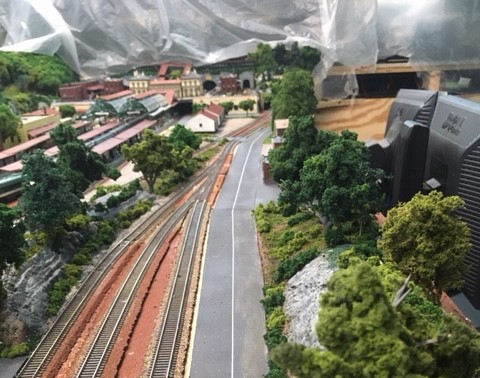 |
Small hillocks and rock outcroppings on Terminal Road by the entrance to the Shops Area - looking West. |
8-28-2020 I have ballasted a bit of mainline track and a section of the entrance to the shops areas, and I have completed a large Walthers Cornerstone grain elevator that will be situated on a small siding between the yard ladder and the shops area.
 |
Grain elevator and the newly ballasted yard ladder track. |
9-24-2020 I have been working on automated schedules that involve the turntable. The sequence I'll use in my grand automation demonstration does the following: calls the turntable to position 3, the track at the far North side or the roundhouse, starts the old switcher that is in that end stall and stops it on the turntable; rotates the turntable to track 9, an uncovered spur South of the roundhouse; moves the loco onto that spur and parks it; waits 8 minutes and then recalls the turntable to position 9 and returns the loco to its original position - all of this with appropriate engine sounds, horn signals when the loco stops and starts, and klaxon warnings when the turntable starts in motion.
At the same time I have, bit by bit, been ballasting the large Terminal yard ladder.
Troubleshooting Problems with the Turntable
10-1-2020
Yard ladder ballasting complete. I removed the dust cover today and ran trains. Things went pretty well, and by day's end I had the full circus of five trains running at once, each making a complete loop around the entire room and returning to its starting place, all this complete with sunrise and sunset lighting sequences, full sound including engine-tracking start, stop, and warning horns, diesel engine sounds, train rattle, air brakes, crossing bells, station announcements, music, narration etc. This included using the net software to move a train from the center bench to the peripheral bench and back using distributed blocks and schedules involving both computers.
The only thing I was not able it include it this extravaganza was the turntable. I am having two problems here. 1. It does not always receive commands generated by calls from the operations tabs in the properties tab of individual blocks in schedules, or from the schedule start or stop tabs themselves. 2. It is receiving occasional "phantom" calls when trains are running under the control of the other computer. So, in one case it is not getting the desired command to move, and in the other case it is receiving and obeying undesired commands to move. I am working on it.
10/8/2020 After posting questions on a few forums, I think I have a handle on the "Phantom" movement problem. It seems that the Walthers turntable will respond not only to the prescribed loconet address for each stop, but also all addresses derived by adding 256 or multiples thereof to the prescribed address. For example in the default case, with the turntable board address set to 57 the loconet address for track 1 is 225 (((57-1) x 4) +1) and the track 2 address = 226, track 3 = 227 and so on. The turntable will also respond to 481 (225+256), 482, 483 etc. as well as to 737 (225 + 256 + 256), 738, 739 etc.
To identify all conflicts, I made a little excel spreadsheet that listed all the addresses I have used on the layout (DS64s, BDL168s, SE8cs, BD4s, PABX1s etc) and then calculated the turnable active addresses for any user-entered board address. The sheet for board address 57 looks like this:
 |
Conflicts appear in red, |
If I select a higher board address like, say, 240, if can avoid any conflicts, and I will only have to change the addresses of the turntable pushbuttons. We shall see.
 |
No conflicts |
However, for what ever reason, I am unable to successfully set the board address to any number higher than 62. So using my spread sheet, I endeavored to find a number below 63 that will avoid conflicts. The chart below shows that 43 is such a number.
 |
No conflicts |
So I set the turntable board address to 43 and reprogrammed the push buttons to 169 thru 177. This seems to work fine, but I will not be able to test for conflicts until I remove the dust cover and run all the trains.
Finishing details on the Altamont Shops Area.
10/10/2020
Over the next few days I'll be painting vehicles and figures for the Shops Area and completing the last of the warehouse/light industrial structures that line the entrance to the terminal yard.
 |
Her is the last to the light industry structures near the entrance to Altamont Terminal: the Old Dominion Broom Company by Bar Mills Model Works. |
 |
I had on hand about 25 40s and 50s period resin-cast vehicles from Fine N Scale, and an assortment of unpainted figures from Preisser. Here are a few of these in place on the layout before I added the grassy boarders and random patches of weeds. |
 |
Here is the same shot after I added the patchs of weeds and grass etc. |
10/13/2020 - Looking at the finished Yard Ladder and the finished Shops and Turntable area, I see large expanses of uninterrupted gravel. This somehow looked a bit unrealistic. So I spent a little tine adding some random patches of wild grass and weeds here and there just to break thinks up and to break up all the long straight edges of pavement and building foundations. This helped a lot.
10-15-2020 Today, I'll install lights in the last few warehouses, the Southern Railway Office building, the grain elevation, and the Bar Mills Broom Company. This will pretty much complete the Shops area and the roadway along the north side of the Altamont Terminal ladder.
Creating a Large Mountain Landscape
10/17/2020
The last 10 or 12 feet of the center bench is open bench work with only the turn-around loop, the auto-reversing cross track, and a spur for my mountain-side saw mill. I have a pretty good idea how I want this area to look: a large, rugged, rocky mountain with a removable steep side covering a good portion of the loop at the end of the bench and a more gentle slope coming up from the center of the bench. As I have already noted in this blog, my 30" loop radii are generous, but they are far, far sharper bends then the bends one would find on a real railroad - ( 30 inches is 400 scale feet, whereas on a real railroad these loop radii might be something on the order of 1500 feet or more) - so they present an unrealistic element, and accordingly, I usually try to cover at least a part of these loops in tunnels.
 |
Here is the track plan. |
 |
And here is the track plan with my very rough topo sketch superimposed. |
The first order of business is to install a good solid cross sectional member to work from. I have cut a cross section of the mountain right at the peak from 3/4 plywood and attached it to a cross-brace of the bench. On the side next to the end of the bench, I will cut a matching piece from 1/2' homasote in order to form a sturdy member which, along with a baseplate, will support the removable hatch on this side of the mountain. This will allow good access to the track in the tunnel. On the side next to the center of the bench, I will attached the lateral homasote forms that will support the more gentle slope.
 |
Central mountain plywood cross-section in place. |
 |
A few homasote forms and the homasote roadway base loosely in place. I have ordered the roadway bridge, and when it is complete, I will cut the roadway base, adjust the roadway elevation, and put the bridge in place. In the meantime, I'll pick up another sheet of homasote and continue work on the mountain frame. |
 |
I am also adding rock walls and outcroppings cut from foam I.S.L.E. multiscale embankments as I go. |
 |
10-22-20 Building the framework. I have changed my technique slightly here. Instead of constructing the entire mountain frame from Homasote, I am using 20 gauge florist wire stapled to the lateral homasote members to make all the cross members. This goes much, much faster, and since the wire can be bent, this technique gives me more control over the contour of the surface. To be sure, this is not as ridgid or as strong as the all-homasote frame, but once the screen is on and the Sculptamold plaster is set, it should be plenty strong enough for fixed terrain. I will continue to use the all-homasote method to provide rigidity and strength to removable hatches and panels etc. |
 |
Here is the entire East end of the center bench framed in with homasote ribs and wire cross members (except for the removable panel that will form the far side of the mountain.) As usual, I set in place the roadway runners and a few flat surface pads for structures, and I then attached the florist wire. I have ordered a number of farm structures (a barn, farm houses, sheds, storage tanks etc ) for the two large pads, and I am waiting for my roadway bridge and an ISLE multiscale embankment to complete the main roadway and a few other rock wall areas. I can then add the plastic screen covering and then begin working with Sculptamold. |
 |
10-27-20 Plastic screen "skin" stapled in place on the mountain. (Note: I always use plastic screen. Although not as rigid as metal screen, it is much easier to work with, and metal screen tends to leave tiny scraps of wire lying about and can thus create a short circuit waiting to happen,) |
 |
Plastic screen "skin" stapled in place on the foothills.I am still waiting for the roadway bridge kit and some more foam rock castings. When these arrive, I can finish positionng the roadway and complete the few remaining rock walls on the mountain. In the meantime, I will begin with the Sculptamold in the completed foothill areas pictured here. |
11-1-2020 Three-and-a-half-day power outage from Hurricane Zeta. Back up and ruuning this morning.
 |
Beginning to cover the sceen on the foothills with Sculptamold. |
 |
Painting first coat on Sculptamold. Only three colors: dark gray for rock, dark brown for forest floor, red clay color for open areas, meadows, and exposed earth embankments etc. |
 |
Zip texturing the earth areas with plaster powder colored
with tempura paint powder sifted onto the earth coloered surfaces, which
have been lightly sprayed with a 50%/50% alcohol and water mix and then
lightly over-sprayed and allowed to dry. Getting the plaster/tumpura
powder mix ecactly the right coilor is tricky. This is a little more
purple than I intended, but I can adjust the color later by mixing a
little of my red-brown earth colored paint or dark brown colored
paint in with the 33%/33%/33% white glue/water/alcohol mix that I will brush on
these areas before sprinkling on the first layer of ground cover. Notice, I have also dry-brushed the exposed rock with a lighter gray latex paint after the dark gray first coat was allowed to thoroughly dry. Once the lighter dry brush over-coat is comeplely dry, I will very lightly dry-brush the rocks again with white. |
 |
11/14/2020 Ground cover applied. For the grass I use three colors of Woodland Scenics fine turf (green grass, mixed grass, and burnt grass.) For the forest floor areas, I use three colors of WS earth tone fine turf, (earth brown, light brown, and yellow), and three colors of WS coarse turf (med. green, dark green,and light green) and miscellaneous twigs and small pebbles, and of course, fine gray mix color ballast gravel for the roads. I first liberally paint an area with a mix of equal parts white glue, water, and alcohol (and a little red-brown latex paint to adjust the color if need be); then I sprinkle on the fine and coarse turf, pat it all down lightly, and then over-spray with a 50/50 water/alcohol mix. Finally, I use white glue to affix the twigs and pebbles. |
 |
11/20/20 Applying bushes, shrubs, and vunes and other landscape greenery using white glue and Woodland Scenics dark green, medium green, and light green foliage and foliage clusters. |
 |
Shrub and bush detail. |
11/25/2020 - I have now nearly completed the "foothill" areas adjacent to my center-bench mountain. All that remains now is to add trees. This is large area, and constructing and "planting" this many trees will take some several weeks. It is tedious business, so I'll do it a little bit at a time. But first I want to complete the structures for two planned areas that feature farming enterprises very typical in the Southern Appalachians where I live: a flat-top hillock for a chicken farm and a small cattle farm at the base of the mountain. I also want to detail a little mountain stream that a have planned, flowing down through the pasture area and down to trackside in a series of waterfalls and culverts.
 |
Chicken farm: this flat graded hilltop and chicken house is typical in the Southern Appalachains as is the cattle farm behind. The left side of the mountain behind the barn with its more gentle slope will be a large mountain pasture. |
 |
Mountain stream passing under road with water falls and a culvert. |
 |
Traickside stream. |
 |
Beginning tree construction and "planting." |
12-11-2020 I got a little sidetracked this week, but I am now back at work on the layout. Before continuing on with tree-making and planting, I took some time to complete the light baffles that hang between the fluorescent fixtures above the center bench. Like and idiot, I began work on the scenery below before hanging the baffles, so I had a tough time mounting the remaining two baffles. The baffles serve to ensure that, when one views the center bench from the end, no exposed light bulbs (either fluorescent or LED) are visible to the viewer. Mounted high in the lighting soffit, they are not visible from anywhere else in the room.

|
Light baffles viewed from the end of the center bench, |
12/20/2020 - I am nearly finished with my tree construction and "planting" for the newly-completed foothills of my new mountain. I have run out of large tree armatures and SuperTree material, I have more on order but stop now for a time an turn my attention to the last few structures.
Go to "Starting Over" Page 5 (12/21/20 to Present)